Average Reviews:

(More customer reviews)About the Reviewer ...
I've played guitar, primarily electric-acoustic, for over 40 years. I toured on and off in my younger years, but currently do mostly house of worship stuff and occasional live music elsewhere.What the heck is a "combo" amp?
A "combo" amp is one that combines the amplifier circuitry or "head" with the speakers in a single cabinet. In the 25-50 lb. variety of smallish, portable combo amps, speaker configurations vary. Some have a single "driver," or "one-way" speaker. Some have two drivers (e.g., two small woofers (Trace TA-50); one large woofer and one piezo tweeter (SWR Strawberry Blonde); two coaxial drivers (Behringer ACX900, UltraSound AG50-DS4, etc.). All in the $250 to $450 price range use a single amplifier, and if there's a separate tweeter at all, it's usually a piezo type that uses passive crossover technology.What the heck do terms like piezo, passive, active and crossover mean?
In any two-way set up using a single amplifier, the tweeter is most likely a piezo type, linked to the woofer with "passive" crossover circuitry. For purposes of this review, the easiest way to describe a piezo tweeter is that it's a kind that, due to its design, can function on a very small amount of electrical energy. That's important in a two-way system using only one amplifier, because there is no separate amp to drive the tweeter ... it piggybacks the electrical current driving the woofer, and the range of frequencies it emits are separated from that current by "in-line" wiring components. The area where the audible frequency response of the two speakers intersect is called the "crossover," and because there is no separate power source for the two speakers, there is no active electronic analysis or control of the individual speakers' crossover frequencies, thus, this configuration is called a "passive" crossover.
In an "active" crossover system, separate amplifiers send power to each speaker, through a linked wiring system that actively and instantly analyzes the signal going to/from each amp, and to/from each speaker, to ensure that only the part of the input signal best suited to that speaker is delivered to the speaker. The result: better speaker efficiency, cleaner sound. Further, a powered, dome tweeter is almost ALWAYS going to sound better than the passive, piezo variety.Why is the speaker configuration important in an "acoustic" combo amp?
Most, if not all, combo "acoustic" amps use a two-way speaker system, because two-way systems generally provide a wider and more detailed frequency response than one-way speaker systems, especially in the high frequencies. Two-way systems used in nearly all combo "acoustic" amps, especially those in the $250 to $450 price range, rely on piezo tweeters and passive crossover circuitry ... because that's all the manufacturers can really afford to offer their customers in that price range. While millions of musicians use, and are very satisfied with these amps, most audio engineers agree that their sound quality is inferior to that produced by bi-amplified (separate amps for the woofer and tweeter) or tri-amplified (separate amps for the woofer, midrange and tweeter) and active crossover circuitry linking them together. Sounds great, right? But of course, there's a downside: since the most expensive part inside an amp tends to be the amplifier core itself (basically a big lump of expensive metal) more amps always means substantially higher cost.About Fishman ...
When it comes to amplification of acoustic instruments, there are few companies with more experience/knowledge than Fishman. Fishman manufactures the "Gold Line" series of under-saddle pickups for Martin, and did the same for Taylor as well, until Taylor started manufacturing its own pickup systems. Their latest "Matrix Infinity" under-saddle and "Rare Earth" soundhole pickup systems are widely praised as the best acoustic guitar pickups in the business.A "long and winding road" to the Loudbox ...
Like any other casual musician, I am always very sensitive to the cost of new gear, and am always looking for a way to save a buck, if I can possibly do so without noticeably affecting the overall quality of my sound. I looked at and tried at least a half-dozen cheap-ish combo amps in the 50-100 watt combo configuration (Fender, Trace, Roland, UltraSound, Genz-Benz, SWR, Behringer, Marshall, etc.) before ultimately buying the Loudbox. I actually purchased an UltraSound AG50-DS4 and "field-tested" it for a few months before selling it (at a loss ... sigh ... chalk it up to "test expense") and buying a Loudbox instead.
I don't mean to diss the DS4 here. In my humble opinion, the DS4 is, far and away, the best 50W acoustic amp available for $450, and it's made entirely in the USA. It uses a single amp, linked to two 8" coaxial drivers. Its ability to faithfully reproduce and amplify the natural sound of guitars and other acoustic instruments is very good. It's housed in a well-constructed and attractive cabinet, and its combination of input options, controls and effects are all top notch for its price range. However, my primary acoustic-electric is a Taylor 816, with Expression system electronics, and as hard as I tried, I just never got entirely comfortable with the way it sounded through the DS4. The upper midrange is pretty dominant in Taylor's Expression system, and I suspected the coax/piezo/passive crossover set up in the DS4 was enhancing the less desirable qualities of my unique pickup system.
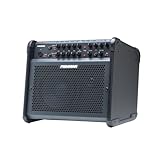
That suspicion was confirmed for me when I finally gave up on the DS4 and went to the Loudbox. The Loudbox is a truly superlative combo amp, because it combines a bi-amplified, active-crossover, two-way speaker system, with plenty of power, in a small, lightweight and yet very durable cabinet. There is really nothing else like it being mass-produced anywhere on planet Earth right now, at least nothing being sold for $600. At this price, it costs quite a bit more than amps like the DS4 ($450), and a LOT more than amps like the Behringer ACX900 ($300), but what you're getting for that extra money is a LOT more in terms of power and sound quality, in a package that's smaller, lighter, tougher and more easily portable than many of the other amps mentioned above. I was so happy, in fact, with the difference in the sound quality between the two amps that I wished I had just spent the extra money and gone with the Loudbox in the first place.About the Loudbox features ...
The Loudbox uses a two-way speaker system consisting of an 8" cone woofer (90W), and a separate, 1-inch dome tweeter (10W), each powered by its own internal amplifier, with active control of the crossover frequencies between the two speakers. There's even a separate external volume control for the tweeter, so you can adjust the tweeter volume to suit your personal taste. Instead of mesh fabric, the speakers are covered by a metal grill, providing solid protection from impact and puncture damage.
The inputs and controls on the Loudbox were carefully designed "with the gigging musician in mind," and they're great. The onboard effects are pretty basic (2 "hall" reverbs, 2 "plate" reverbs and 1 chorus), but each of them is high quality, and very useable. The amp's two input channels each have their own, separate gain, 3-band EQ and effects controls. The channel 1 input is a ?" TS; channel 2 allows you to use either a balanced XLR input, or a ?" TS. Switchable phantom power is available for the channel 2 XLR input, if needed for your mic or other input device. The channel 2 ?" TS input is also wired in tandem with channel 1 to allow "stereo" blending of instruments wired with two pickup sources (e.g., transducer and mini-mic), although use of the channel 2 input in this way takes up both channels in the amp, and prevents simultaneous use of the other channel.
It's a perfect amp for small venue musicians who need one input for instrument and one for voice, and can easily double as a small PA. Rear panel inputs/outputs include separate external effects sends/returns for each channel, XLR direct out, and an aux input that bypasses the mute switch on the front panel, e.g., so you can run pre-recorded music through the amp on breaks, with the channel 1 and 2 inputs muted. Additional details and complete technical specs are readily available by viewing the owner's manual on the Fishman website.
My Loudbox included Fishman's custom cordura nylon case, which I consider an essential accessory. This beefy case, with Fishman's logo nicely embroidered on the front, has strong polymer skid plates on the bottom; velcro fastener for the lid; a flap on the top which allows you to grab the amp's carrying handle with the lid down; a zippered pouch on the back for your power cable, manual and accessories, and protects the amp from dust intrusion and damage while the amp is being stored and moved around.
The "cons" of this amp, if any, are very minor. First, the polymer caps on the bottom edges have no separate rubber feet or other non-skid material at the points where they contact the floor. So if you're using the amp on a slick surface like hardwood or tile, the amp will slide around if pulled on or bumped. You'll need to add some skid-resistant material to the base, or add a skid-resistant pad to your accessory list. Second, the pinions for the rotary controls on the front panel are made of plastic (not metal) and they're not bolted to the metal faceplate ... they just protrude from the underlying circuitboard through corresponding holes in the faceplate, then covered with snugly-fitting plastic knobs. They're going to be...Read more›
Click Here to see more reviews about:
Fishman Loudbox 100 Get 35% OFF
Click here for more information about Fishman Loudbox 100